Forex trading for beginners starts with a broker, a demo account and one risk rule per trade
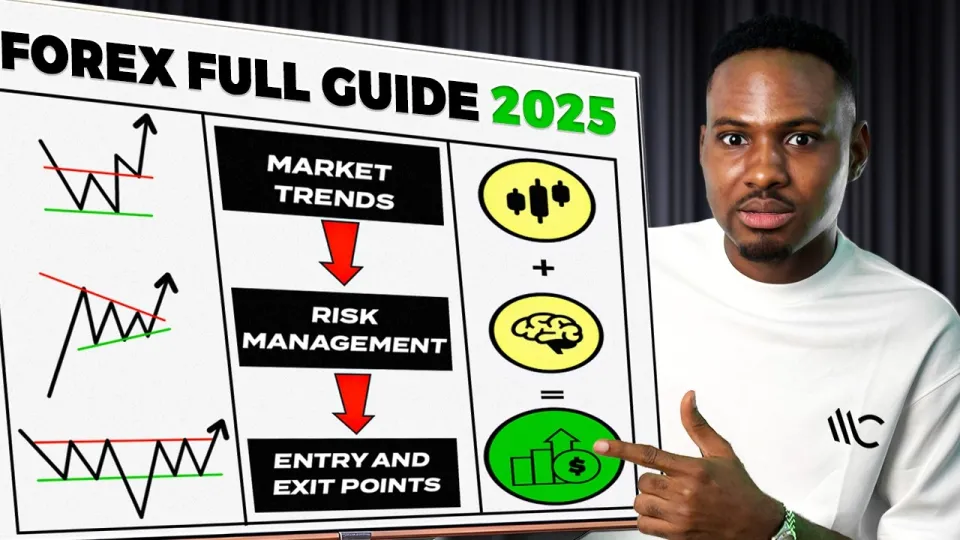
Video: How To Start Forex Trading For Beginners’ 2025 (Full Course)
You can order the same kind of articles for your own video to boost it on YouTube and Google. Just message the Telegram bot @sat_sit_bot. It writes articles around your video, embeds the video and publishes them on popular niche websites (no ads). Free trial — 50 articles.
· based on the channel Jeffrey Benson Forex
Key takeaways
- Forex is an over-the-counter market where currencies are quoted in pairs such as EUR/USD; there is no central exchange and trading runs 24 hours a day, five days a week.
- Four sessions set liquidity: Sydney, Tokyo, London and New York, with the London-New York overlap usually the busiest window.
- A beginner needs three things before risking money: a regulated broker, a platform such as MT5, and a written risk limit per trade.
- A common beginner ceiling is 1% of account equity risked per trade, so a $1,000 account risks about $10 on a single position.
- Jeffrey Benson Forex structures its free course from definitions and market mechanics to tools, strategy, a first trade and a list of common mistakes.
Forex trading for beginners means buying and selling currency pairs through a broker on an over-the-counter market, and the shortest safe path is to learn how quotes and sessions work, open a demo account on a platform such as MT5, cap risk at roughly 1% per trade and only then fund a live account. Jeffrey Benson Forex lays out that sequence in a full beginner course, and students who want structured follow-up can compare the paid plans at FirePipsFX. The material below stands on its own: it explains the mechanics, the toolkit and the risk arithmetic a new trader needs before the first click.
What forex trading actually is and how a currency pair is quoted
Forex is the market where one currency is priced in another, and every quote is a ratio between two economies rather than a price tag on a single asset. The euro against the US dollar, written EUR/USD, is the most heavily traded pair; the first currency is the base and the second is the quote, so a EUR/USD price of 1.0850 means one euro buys 1.0850 dollars. A long position profits when the base currency strengthens, a short position profits when it weakens.
Three details separate forex from buying a stock. First, there is no central exchange: trades are matched through a network of banks, brokers and liquidity providers, which is why spreads and execution vary by venue. Second, the market runs around the clock from Sunday evening to Friday evening, so a beginner can trade outside a day job. Third, leverage is standard, and that is the feature that most often destroys small accounts when it is used without a risk limit.
Currency moves are driven by interest-rate decisions, inflation prints, employment data and risk sentiment. A trader does not need to forecast an economy; a trader needs a repeatable reason to enter and exit, plus a rule for how much is at stake. That distinction is the core of the beginner course published by Jeffrey Benson Forex, which treats definitions as the foundation rather than an afterthought.
How the forex market works across four sessions
Liquidity in forex follows the sun, and the trading day is divided into the Sydney, Tokyo, London and New York sessions, each with its own character. The London session is the deepest for European and US dollar pairs, and the overlap between London and New York is usually the busiest window, with tighter spreads and larger ranges. Tokyo tends to favour yen and Australian dollar pairs, while the late New York hours are thinner and prone to erratic moves.
Session timing matters for a practical reason: a strategy tested on London liquidity can behave differently in the quiet hours before Asia opens. Many beginners keep a notebook of session behaviour for a few weeks and discover that their best setups cluster in one or two windows. Writing this down, rather than watching passively, is the habit experienced viewers of beginner tutorials recommend most often.
The tools a new trader needs before the first trade
The minimum toolkit is a regulated broker, a trading platform, a charting setup and a journal. A broker holds the account and provides pricing; check its regulatory status, its spread on the pairs you intend to trade and its withdrawal process before depositing anything. MetaTrader 5 (MT5) is the platform most beginner courses demonstrate, and it covers charting, order types and a demo mode that mirrors live conditions.
A workable starting setup looks like this:
- Open a demo account and fund it with virtual capital equal to the real amount you plan to risk.
- Set the chart to a higher timeframe for direction and a lower one for entry timing, for example daily and one-hour.
- Add only a couple of tools, such as a moving average and a support-resistance read, so the screen stays readable.
- Record every trade: pair, session, reason for entry, stop distance, result and a one-line lesson.
A journal is not bureaucracy; it is the only way to tell whether a result came from a repeatable process or from luck. The same logic applies to signal services and copy-trading offers, which are common in this niche. FirePipsFX, the service linked from the course, runs a free daily signal channel at https://t.me/firepipsignals and a premium group reached through https://t.me/jeffreybenzhelpbot; a beginner should treat such services as a study aid and verify the risk behind each call rather than following them blind.
Building a basic strategy foundation before placing money
A basic forex strategy is a defined answer to three questions: where do I enter, where am I wrong, and where do I take profit. Most beginner frameworks start with trend direction on a higher timeframe, a pullback to a level such as a moving average or a prior support zone, and a confirmation candle before entry. The stop loss goes beyond the level that would invalidate the idea, and the target is set at a multiple of that distance, commonly 1.5 to 2 times the risk.
Position size is then calculated from the stop distance, not guessed. With a $1,000 account and a 1% risk limit, the maximum loss on a trade is $10; if the stop sits 20 pips away on a standard lot, the position must be cut down accordingly. This arithmetic is what turns a strategy into a business plan, and it is the part beginners most often skip.
A simple checklist keeps the process honest:
- Is the higher-timeframe trend clear, or is the market ranging?
- Is price at a level where a stop can be placed logically?
- Does the reward-to-risk ratio reach at least 1.5?
- Is the session liquid enough for the pair?
- Has the daily loss limit already been hit?
Placing a first trade and the risk rules that protect the account
The first live trade should be small enough that a loss changes nothing except the journal entry. On MT5 the sequence is: select the symbol, choose market or pending order, set the lot size derived from the stop distance, attach the stop loss and take profit, and confirm. Before confirming, check the spread and the margin requirement, because leverage magnifies both profit and error.
Risk rules worth writing down and keeping visible:
- Risk no more than 1% of equity per trade, and 2% to 3% across all open positions.
- Cap the daily loss at 3% to 5% of equity and stop trading when it is reached.
- Never move a stop loss further away to avoid taking a loss.
- Trade one or two pairs during the learning phase rather than a dozen.
- Keep leverage modest relative to the account; high leverage is a sizing tool, not a strategy.
Common beginner mistakes and the questions new traders keep asking
The most expensive beginner mistakes are structural rather than technical: oversized positions, no stop loss, revenge trading after a loss and switching strategies before any of them has a sample size. A trader who risks 10% per trade can lose half an account in a handful of bad outcomes, while the same losing streak at 1% risk is survivable and instructive.
Questions raised by viewers of beginner courses tend to repeat. How long before results appear? A realistic answer is months of demo and small live trading, measured in journal entries rather than calendar promises. Is a paid course necessary? Not necessarily; free material covers the mechanics, while paid mentoring mainly buys structure and feedback. Can signals replace learning? No, because a copied trade without the reasoning behind its stop cannot be managed when the market moves. Which pair first? A major such as EUR/USD, because spreads are tight and analysis is widely available.
Useful links from the course
- Paid mentorship and student plans: https://firepipsfx.com/plans
- Free daily signal channel: https://t.me/firepipsignals
- Broker registration used in the course: https://my.assexmarkets.com/auth/register?partner_code=1699134
- Premium signal group access: https://t.me/jeffreybenzhelpbot
Bottom line on starting forex trading
Forex rewards process discipline far more than prediction, and a beginner who learns quotes, sessions, a simple strategy and position sizing before funding an account avoids the mistakes that end most trading careers early. Start on a demo account with the same risk rules you will use live, journal every trade and keep position size small enough that a losing streak teaches instead of destroys. The full beginner walkthrough from Jeffrey Benson Forex covers exactly this ground, from market mechanics to a first order and a list of traps to avoid. When you are ready for structured support, review the student plans at FirePipsFX and treat any signal service as a supplement to your own risk rules.
Questions & answers
How much money do I need to start forex trading?
There is no fixed minimum, but the account size must fit the risk rule. If you risk 1% per trade, a $500 account risks $5 per position, which is workable on micro lots but leaves little room for error. Many beginners spend several months on a demo account first and fund live trading only with money they can afford to lose.
Is forex trading profitable for beginners?
Most beginners lose money at first, usually because of oversized positions and missing stop losses rather than bad analysis. Profitability tends to follow a tested strategy, a written risk limit and enough journaled trades to show an edge. Treat early results as tuition, not as a verdict on the market.
Can I copy trades instead of learning to trade?
Copying trades is possible through signal channels and mirror-trading features, and it can shorten the learning curve for observing how entries and exits are structured. The risk is that a copied position arrives without your own stop logic, so you cannot manage it when conditions change. Use copied trades as study material and keep your own risk limits in place.
Which platform should a beginner use for forex?
MetaTrader 5 is the most common choice in beginner courses because it offers charting, pending orders, a demo mode and broad broker support. The platform matters less than the broker behind it: check regulation, spreads on major pairs and how withdrawals are handled before depositing funds.
Source: How To Start Forex Trading For Beginners’ 2025 (Full Course) · Markdown version